How Effective Are ChatGPT Ads For Dental Practices?
Quick Answer
ChatGPT Ads can work for some dental practices, but they are new and still unproven in dentistry. Dental services are only allowed after OpenAI reviews each practice, ads never appear next to personal health conversations, and early results across industries show lower conversion rates than Google Ads. Treat them as a small, measured test alongside Google Ads and SEO, not a replacement.
Last updated: 23 October 2026. ChatGPT Ads change quickly, so we review this guide regularly.
Key Takeaways
- Dental is allowed, case by case. Dental services are on OpenAI’s approvable health list, but each practice goes through manual review.
- Placement is limited. Ads stay out of personal health conversations, so they mostly reach people researching treatments and costs.
- Early results are mixed. In four published side-by-side tests, Google Ads converted better every time.
- No dental results are public yet. Any claim of proven dental performance should be treated with caution.
- Organic AI visibility still matters most. Being recommended in the answer itself is free and often converts better than the ad below it.
What Are ChatGPT Ads?
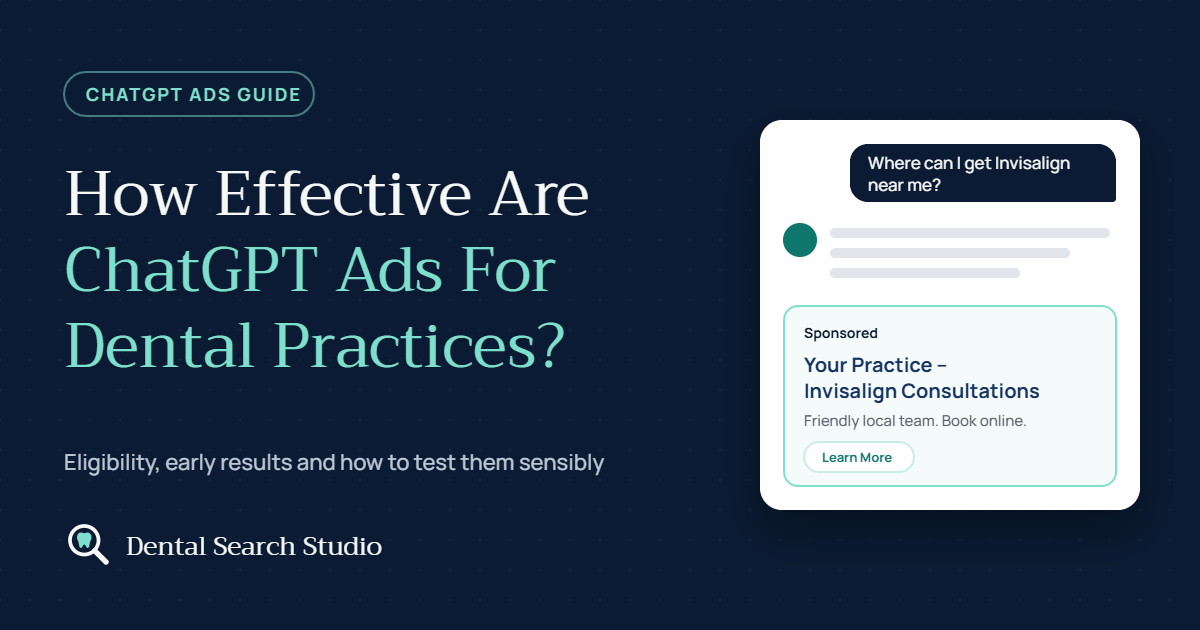
ChatGPT Ads are sponsored placements that appear below ChatGPT’s answers when an advertiser’s offer is relevant to the conversation. They are clearly labelled and kept separate from the answer, and OpenAI says advertisers receive aggregated performance data, not people’s conversations (OpenAI, May 2026).
- Who sees them: adult users on the Free and Go plans. Paid Plus, Pro, Business and Enterprise users do not see ads (Denali Creative, October 2026).
- How you pay: per click (CPC) or per thousand impressions (CPM), through a self-serve Ads Manager that opened in May 2026 with no minimum spend (OpenAI).
- How big it is: as of 21 October 2026, ChatGPT Ads are available in 89 countries, ChatGPT has over 1.2 billion weekly users, and more than 100,000 advertisers have run campaigns since launch (PPC Land, October 2026).
- Tracking: a pixel and Conversions API let you measure leads and bookings from your website (OpenAI).
Can Dental Practices Advertise On ChatGPT?
Yes, but not automatically. OpenAI lists dental services among the health categories it may approve, and every health advertiser is reviewed individually rather than approved as a category (Search Engine Journal, August 2026). OpenAI may also ask for proof of licensure (OpenAI ad policies).
What Limits Apply To Dental Ads?
- No ads beside personal health chats. OpenAI keeps ads out of sensitive personal and mental health conversations (SEJ). If someone describes tooth pain, your ad is unlikely to appear.
- Availability depends on your market. Health eligibility has expanded in stages, so check the current policy for your location before planning a budget.
- Claims must be careful. Guaranteed results, “pain-free” promises and unsupported before-and-after claims are likely to be rejected (Denali Creative).
- The rules keep changing. OpenAI’s ad rules changed four times between March and August 2026 (SEJ).
How Effective Are ChatGPT Ads? The Early Data
There are no published ChatGPT Ads results for dental practices yet, and OpenAI does not publish official benchmarks (PPC One, October 2026). The best evidence so far comes from early advertisers in other industries:
| Metric | What Early Data Shows | Source |
|---|---|---|
| Click-through rate | Pilot average of about 0.68%. Across 24 published campaigns, CTR ranged from 0.35% to 7.9%, with half below 1.25%. | PPC One |
| Cost per click | Across 15 published campaigns billed in US dollars, about 0.76 to 14.80 dollars, median about 4.41 dollars. | PPC One |
| Conversion rate vs Google Ads | In four same-advertiser comparisons, Google Ads converted better every time (for example 0.8% vs 6.64%). | PPC One |
| Longer tests | One advertiser’s cost per lead started at over 3× search, was roughly level by month four and about 35% lower by month six. | PPC One |
| Healthcare ad frequency | In a study of 50,006 commercial prompts, ads appeared on 28.69% of healthcare prompts. | SEJ / SE Ranking |
The pattern is clear: ChatGPT Ads can deliver cheap clicks and, in some longer tests, competitive lead costs. But most short tests convert worse than Google Ads, and several advertisers reported conversions that did not match real enquiries (PPC One).
Where ChatGPT Ads Could Work For Dentists
Because ads stay out of personal health conversations, they are best suited to research-stage questions, where people compare options before choosing a practice. For example:
- Comparing Invisalign and braces, or clear aligner providers
- Researching dental implant options and what affects the price
- Looking for a practice that accepts new patients or offers evening appointments
- Exploring cosmetic treatments like whitening and veneers
High-value treatments with a long decision process are the most promising, because one booked consultation can justify the cost of testing.
Where ChatGPT Ads Fall Short
- Lower intent than search. People asking ChatGPT are often still researching, while people searching Google for “emergency dentist near me” want to book now.
- Eligibility uncertainty. Approval is individual, and availability for health advertisers varies by market.
- Tracking gaps. Early advertisers found Ads Manager and analytics did not always agree, so you need your own call and form tracking.
- A fast-changing platform. Rules, formats and pricing are still evolving, which makes long-term planning harder.
ChatGPT Ads Vs Google Ads Vs AI Search Optimisation
| ChatGPT Ads | Google Ads | AI Search Optimisation | |
|---|---|---|---|
| Patient intent | Researching and comparing | Ready to book | Researching and comparing |
| Where you appear | Below the AI answer | Top of Google results | Inside AI answers |
| Cost | Pay per click or impression | Pay per click | No ad spend |
| Proven for dentists | Not yet | Yes | Growing evidence |
| Best use | Small, measured test | Core enquiry driver | Long-term visibility |
Many practices will get more value from being recommended in ChatGPT’s answers than from the ad below them. In one published comparison, a software seller’s unpaid ChatGPT recommendations converted at 4.2%, against 0.46% for its paid ads (PPC One). Learn how Dental SEO and AI Search Optimisation help your practice get mentioned.
How To Run A Sensible First Test
- Check eligibility first. Confirm your practice and location can advertise, and have your licence details ready.
- Choose one or two treatments. Focus on high-value treatments such as implants or Invisalign.
- Prepare a strong landing page. Clear pricing information, reviews and an easy booking form.
- Set up tracking. Use the OpenAI pixel plus your own call and form tracking.
- Start small with CPC bidding. Keep the test budget modest and cap your bids.
- Judge by booked consultations. Compare cost per booked consultation with Google Ads for the same treatment, not just clicks.
If you would like help, our ChatGPT Ads service for dental practices starts with an honest eligibility check, and we will tell you if it is not a good fit yet.
Our Verdict
ChatGPT Ads are a promising new option, but not yet a proven one for dentistry. For most practices, the order of priority is: strong Dental SEO and AI visibility, then Google Ads for patients ready to book, then a small ChatGPT Ads test for high-value treatments once those foundations are in place.
FAQs
Are ChatGPT Ads worth it for dental practices?
They can be worth a small, measured test for practices that already have strong foundations such as Google Ads, a good website and solid reviews. There are no published dental results yet, and early data across industries shows lower conversion rates than Google Ads, so they should not replace proven channels.
Can any dental practice advertise on ChatGPT?
No. Dental services are on OpenAI’s list of approvable health categories, but every health advertiser is reviewed individually and may need to provide proof of licensure. Availability for health advertisers also depends on your market.
Where do ChatGPT Ads appear?
Ads appear below ChatGPT’s answer, are clearly labelled as sponsored and are kept separate from the answer itself. They are shown to adult users on the Free and Go plans, not to paid Plus, Pro, Business or Enterprise subscribers.
Will my ad show when someone describes a dental problem?
Not when the conversation is about personal health. OpenAI keeps ads out of sensitive personal and mental health conversations, so dental ads are more likely to appear in research-style chats, such as comparing treatment options or costs.
How much do ChatGPT Ads cost?
There is no minimum spend. You can bid per click or per thousand impressions. In one review of published campaigns billed in US dollars, cost per click ranged from about 0.76 to 14.80 dollars, with a median of about 4.41 dollars.
Can I pay to be recommended inside ChatGPT’s answer?
No. Ads are separate from answers. To be mentioned in the answers themselves, you need AI Search Optimisation: clear practice information, helpful treatment pages, reviews and structured data.
Find Out If ChatGPT Ads Suit Your Practice
Get a free, no-obligation review including an eligibility check for ChatGPT Ads, plus clear recommendations on SEO and Google Ads.
Sources
- OpenAI: New ways to buy ChatGPT ads (5 May 2026)
- OpenAI: Ad policies
- Search Engine Journal: OpenAI Allows Some Health & Finance Ads In ChatGPT (12 August 2026)
- PPC Land: ChatGPT ads expand to 89 countries (21 October 2026)
- PPC One: International ChatGPT Ads results (updated 14 October 2026)
- Nakora: ChatGPT Ads benchmarks (September 2026)
- Denali Creative: ChatGPT Ads for dental, eye and cosmetic practices (2 October 2026)